The Barrier to Entry has Collapsed
For years, the primary barrier to starting a business was the “capital hurdle.” Entrepreneurs believed that before they could send their first invoice or land their first client, they needed a significant budget for software, branding, and infrastructure. This belief created a culture of delay, where “planning” became a permanent substitute for “doing.”
From a Lean Startup perspective, this is a fatal error. High upfront costs don’t just drain your bank account; they destroy your ability to pivot. In reality, we have entered an era of “zero-burn infrastructure.” To prove the point: I successfully operated a Virtual Assistant (VA) company with 30 staff members for 24 months on a total software budget of $0. This approach isn’t just about saving money; it’s a high-level risk-mitigation strategy. By utilizing “tech-stack arbitrage,” you create a fail-fast environment where the cost of a mistake is $0.

The “Unlimited” Power of Free Tiers
Many entrepreneurs avoid free versions of software because they fear “hitting a paywall” at the exact moment their business begins to grow. However, current market offerings have shifted the “Free” vs. “Paid” dynamic. You can now scale significantly across CRM, forms, and email without spending a dime.
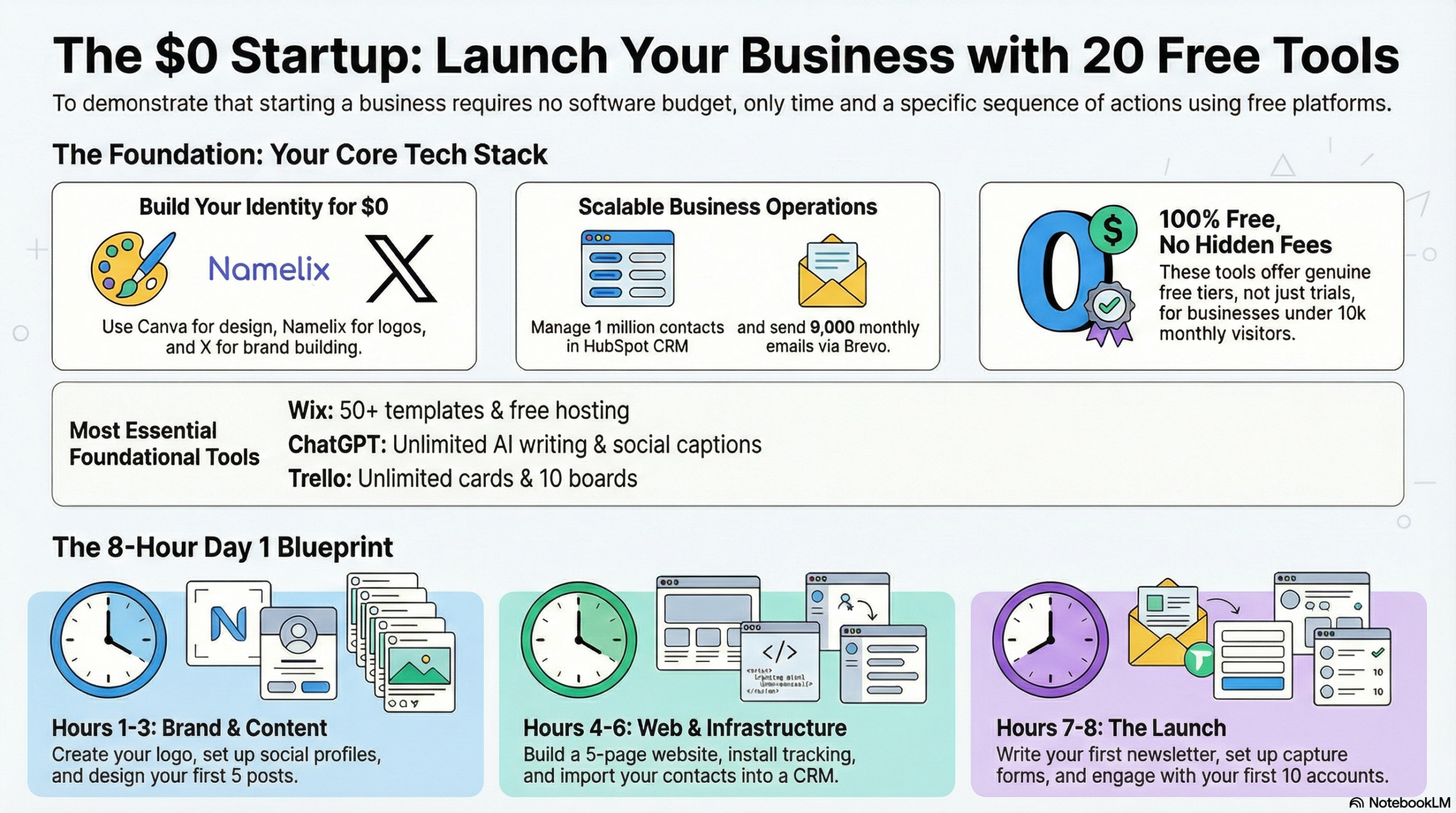
• HubSpot CRM: Offers storage for up to 1,000,000 contacts and includes deal pipeline tracking and meeting schedulers for free.
• Tally Forms: Provides a rare “unlimited” model with unlimited forms and unlimited submissions, including conditional logic and no forced branding.
• Brevo: Allows you to send 9,000 emails per month to a limit of 100,000 contacts, providing enterprise-grade automation for $0.
These limits aren’t “trials”—they are strategic foundations. They allow a small business to move from its first customer to its ten-thousandth without the pressure of an increasing monthly subscription bill.
Automation is the Great Equalizer (The n8n Factor)
Operational efficiency used to be a luxury reserved for large corporations with custom-coded backends. Today, automation is the great equalizer. By using n8n, a solo founder can achieve the technical throughput of a 10-person operations team.
The strategic advantage of n8n is that it is self-hosted and open-source. Unlike competitors like Zapier, which charge “per task”—creating a variable cost that punishes you for being successful—n8n is 100% free with no task limits. This “sweat equity” approach requires you to host the tool yourself, but the reward is a zero-cost engine that saves 10+ hours weekly on repetitive administrative tasks.
“The real cost? Your time learning each tool.”
Building a Foundation in Exactly Eight Hours
In a Lean Startup, speed is the only metric that matters. The shift from “planning” to “executing” can happen in a single business day. Use this hour-by-hour blueprint to move from zero to a live, professional brand:
Brand & Identity
• Hour 1: Generate a logo on Namelix and create an X (Twitter) business profile.
• Hour 2: Design 5 initial social media posts using Canva’s free templates.
Web & Data
• Hour 3: Build a 5-page, mobile-responsive website using Wix.
• Hour 4: Set up the Google Analytics tracking code to monitor user behavior.
Outreach & Management
• Hour 5: Create your HubSpot CRM and import your initial lead list.
• Hour 6: Write your first community newsletter on Substack.
• Hour 7: Deploy a Brevo email capture form on your website.
Engagement
• Hour 8: Officially launch by posting on X and engaging with 10 target accounts.
The Revenue Model of “Free” (Ko-fi vs. Substack)
Traditional Software as a Service (SaaS) wins even if your business fails. The Lean Startup Strategist, however, looks for “Partnership” models. This is where the fee structure of platforms like Ko-fi and Substack becomes a massive strategic advantage.
• Ko-fi: Offers 0% fees on donations and a 5% fee on digital product sales.
• Substack: Provides free publishing and list management, taking a 10% fee only when you choose to monetize.
By moving from fixed costs (monthly subscriptions) to variable costs (transaction fees), you eliminate “zombie subscriptions” that drain your bank account during slow months. These platforms only make money when you make money, aligning their success directly with yours.
The “Action over Assets” Philosophy
The ultimate takeaway is that your “stack” is secondary to your output. I have coached over 50 entrepreneurs who built businesses generating $3,000 to $10,000 per month using these exact free tools. Their success wasn’t rooted in a premium subscription; it was rooted in “30 days of daily execution.”
The tools—from Brevo’s 9,000 monthly emails to Tally’s unlimited submissions—are already waiting for you. The bottleneck is no longer the wallet; it is the willingness to act.
“The ‘I need money to start’ excuse is dead.”
Conclusion: Your Move
The “Zero Dollar” philosophy proves that the tools required to build a professional, scalable company are now accessible to anyone with an internet connection and the time to learn. By prioritizing high-capacity free tiers and variable-cost platforms, you remove the financial risk of failure. The only remaining question is: If the software is free and the blueprint is ready, what is actually stopping you from starting today?